| Example 14.2 : Balanced RLC LPF, with
Differential and Common mode Load
Analyze the following circuit in both common and differential mode:
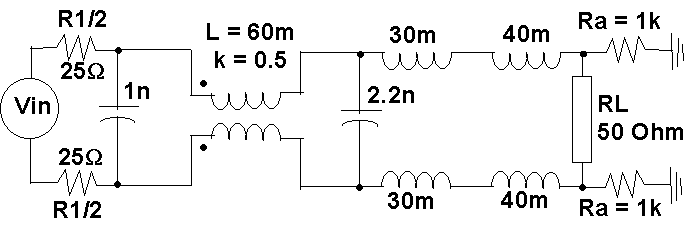
Figure 14.1 : The network to Analyze
Differential mode: Using network 240 (n=2, p=4), the transformer
is replaced with
L1/2=(1-0.5)*60=30E-03 Henry, and the two inductors in series are L2/2=30+40=70
mH.
The two capacitors are C1=1n and C2=2.2n.
The load RL includes Ra, so R2 = 2k || 50 = 48.78 W.
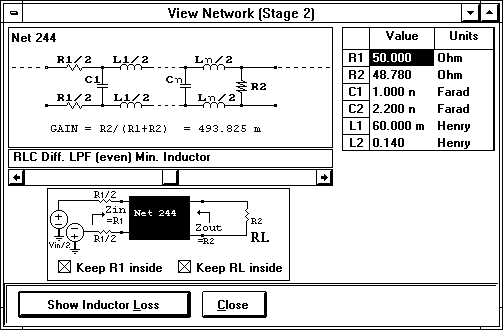
Figure 14.2 : Differential Mode Equivalent Network
Common mode: The transformer is replaced with (1+0.5)*60=90
mHenry inductor, and the two inductors in series are 30+40=70 mH. In common
mode, the two capacitors are open circuits, so 0.5 pF is used.
The load RL is open circuit as well, but the load Ra = 1k, is still
effective.
You can save some of those tedious translations, by simple using network
144 :
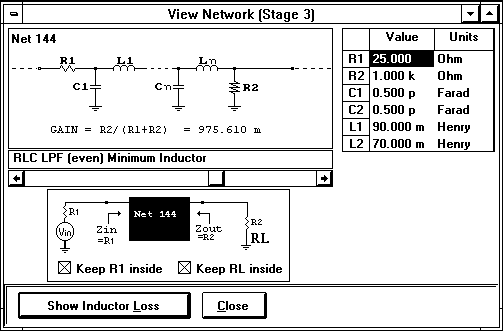
Figure 14.3 : Common Mode Equivalent Network
When analyzing the above LPF networks, the differential mode has a 3
dB point at 78 Hz, while the common mode has its 3 dB point at 1.020 kHz. |